ARR exposure is binding
Customer Success
Limited Customer Success capacity engagementsProve the Customer Success capacity plan.
Know whether to hire, rebalance, or change coverage policy — with the accounts, ownership, roster, renewal exposure, and assumptions behind the decision.
Same capacity state
Different binding constraint
Account volume is binding
Cross-functional decision
Capacity planning breaks when every team has a different version of the truth.
A capacity decision does not stay inside CS. Finance needs evidence, Talent needs timing, Operations needs approved assumptions, and leadership needs confidence that the book can be supported.
Illustrative example
Active baseline
Decision
Review targeted rebalance before opening net-new headcount.
Recommendation
Move three Enterprise accounts into an eligible owner pool before approving a new role.
Capacity gap
+2.6 FTE
Decision-ready evidence
- Required FTE
- 12.4
- Effective supply
- 9.8
- Binding constraint
- Renewal exposure
Scenario comparison
- Current baselineGap persists
- Rebalance 3 accountsPressure reduced
- Open new roleSupply follows ramp
Approved assumptions
Enterprise target · Ramp factor · Coverage model · Renewal window
Missing evidence
Missing ARR · Unapproved segment target · Unresolved ownership
- Customer SuccessWhere is the team stretched?
- FinanceIs this fundable?
- TalentWhen should the role open?
- OperationsWhich assumption drives the gap?
- LeadershipCan we support the book we already have?
OpX keeps the debate on the decision, not a disputed spreadsheet.
The operating questions
Customer Success capacity is rarely one problem.
A team may be overloaded by account volume, commercial exposure, renewal concentration, ramped supply, poor fit, or missing operating assumptions. OpX separates those constraints so leaders can see what is actually binding.
Live capacity model
A capacity spreadsheet goes stale the day after it is built.
An account churns. A renewal date moves. A deal closes. A CSM goes on leave. A new hire ramps more slowly than expected. A segment gets redefined. The model still looks precise, but it no longer represents the business.
Precise on the day it was built.
Accounts, ARR, ownership, renewal exposure, roster, ramp, assumptions, and scenario plans.
Rebalance the book
Model what happens when accounts move between owners before making the change.
Pressure-test assumptions
Change targets, ramp, service cadence, duration, or coverage policy to see which constraint becomes binding.
Plan ahead
See what today's book of business could look like next quarter or two quarters from now.
Planning assumption
AI productivity gains are an assumption teams can model, not a blanket reduction claim. Test the effect on service cadence, duration, ownership, ramp, and effective capacity before it changes the headcount plan.
Capacity decision
Open with the decision, then trace it to the model.
OpX puts the capacity position, business context, and available rebalancing path in one view, with segment-level evidence beneath it for the team that needs to evaluate the plan.
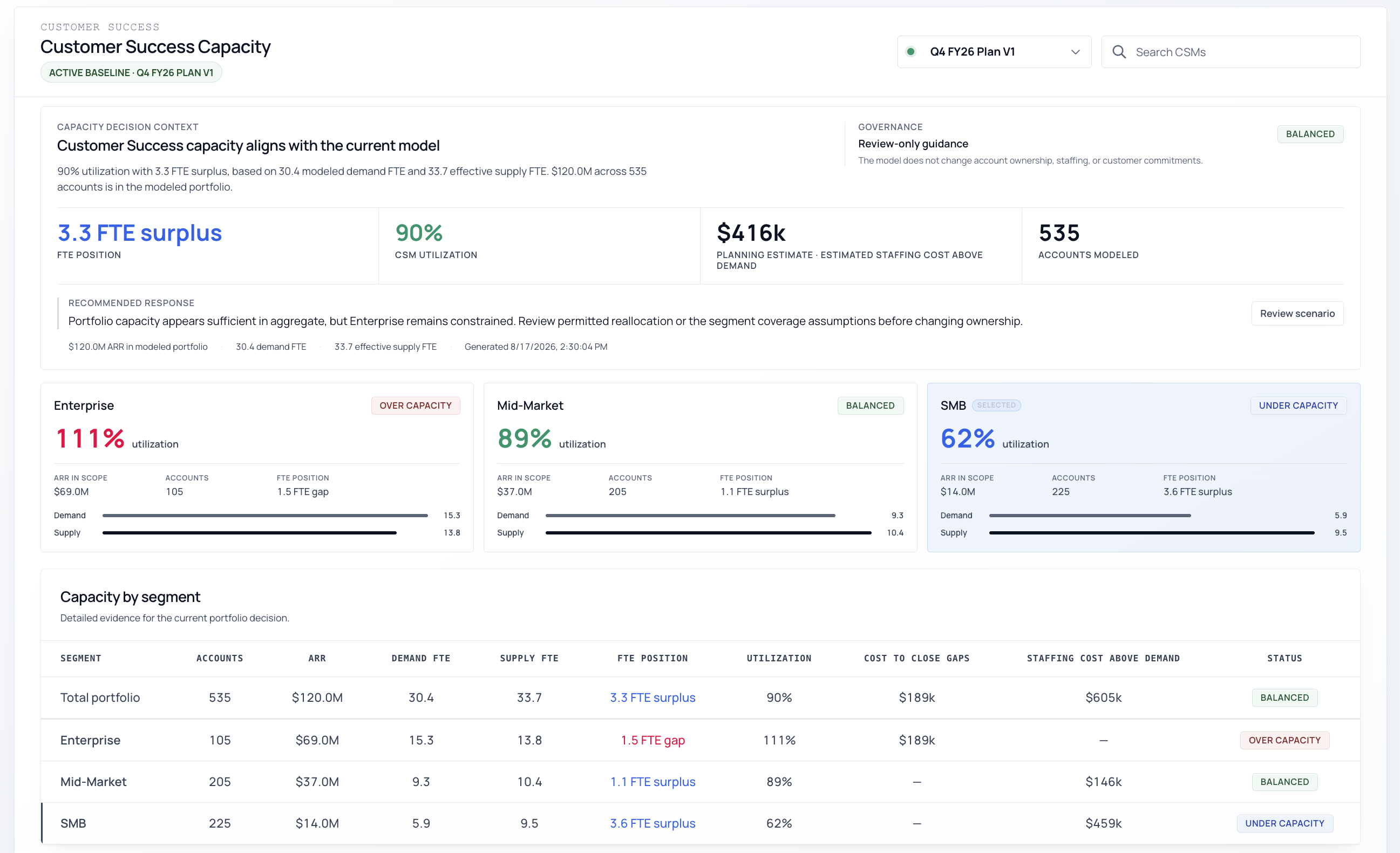
Current platform view. Q4 FY26 Plan V1, capacity position, modeled book, and segment evidence are shown together.
Decision model
A credible plan starts with approved assumptions.
Customer demand, effective supply, and coverage policy remain visible so the capacity answer can be challenged, reviewed, and approved.
Required FTE by segment
Capacity demand is calculated from the customer's approved account and ARR targets, not generic benchmarks.
Effective supply
Rostered supply is adjusted for ramp, because a CSM in month three is not a full head.
Binding constraint
Each book is evaluated by account volume and ARR exposure, and OpX shows which one is driving capacity.
FTE gap
The result is expressed in FTE, the language a headcount request is actually made in.
Model governance
The plan is only as credible as the assumptions behind it.
Customer segments, capacity method, targets, and ramp assumptions are visible parts of the planning baseline, so a scenario can be traced back to the choices that produced it.
Coverage policy
Segment targets and service expectations remain visible inputs to the plan.
Effective supply
Roster availability and ramp shape the capacity the team can actually use.
Scenario authority
Teams review and approve the assumptions before a result becomes decision-grade.
Assignment evidence
Every assignment is reviewed from four angles.
Available bandwidth
Measures whether the account can be carried without pushing the owner past safe utilization.
Proximity to the customer
Checks whether the assigned CSM is geographically or time-zone aligned with the account.
Expertise fit
Checks whether the account segment matches the CSM's proven book of business and operating context.
Renewal concentration
Checks whether too many renewals are clustered on the same owner in the same period.
Allocation intelligence
See the fit behind every assignment.
OpX shows the evidence behind the current owner and eligible alternatives before an assignment change is considered.
When OpX cannot answer, it says so
OpX does not turn missing inputs into false precision.
Missing ARR appears as a data gap, not a zero. A segment without an approved target reads not evaluable. Demand with no rostered supply returns a named state, not a misleading 0%.
OpX shows the gap before it shows the answer.What a capacity review includes
No integration is required to begin.
Start with a sample review, not an integration project.
OpX begins with a bounded operating question, reviews a sample first, and only uses approved mappings and assumptions before they affect the model.
- Inputs
- Accounts, roster, ownership, assumptions, and renewal exposure when available.
- Customer roles
- Customer Success owner, data or systems owner, and Finance or Operations when planning is affected.
- Working sessions
- Mapping review, assumption approval, model walkthrough, and operator validation.
- Outputs
- Capacity gap, binding constraints, scenario comparison, data gaps, and decision brief.
- Boundary
- No integration project is required to begin. Production data follows approved mappings, assumptions, and engagement terms.
- After the review
- Use the model to support hiring, rebalance, coverage-policy, or next-deployment decisions.
If you lead Customer Success and want to see what your capacity actually looks like, start a capacity review.
